

Week 5 saw the remaining six competitors making plates of realistic knit and crochet food, and working in teams of two to create heavily textured cardigans.
With five weeks of competition behind them, the six remaining contestants were thrown challenges to take them out of their comfort zones. Despite this, Simon demonstrated how much he had improved his crochet skills, and Isaac delved into the details of how he created his response to the individual task.
Individual task
This week, the contestants had twelve hours to create a plate of delicious-looking food where each item was in proportion to the others. We saw a breakfast fry-up, a brunchtime burger, Sunday lunch, two pasta dishes, and a traditional East End pie and liquor. We saw a mix of crochet and knitting, with yarns far thinner than we are used to seeing on the programme. While having a Masterchef-like plating up, at 12h the knit and crochet versions took far longer than their real-world dishes would have taken (unless you take into account the Great Pottery Throw Down and the kiln time for the plates).
Knitted and crocheted food is a common novelty make. Here are two examples from the Knitting & Crochet Collection.
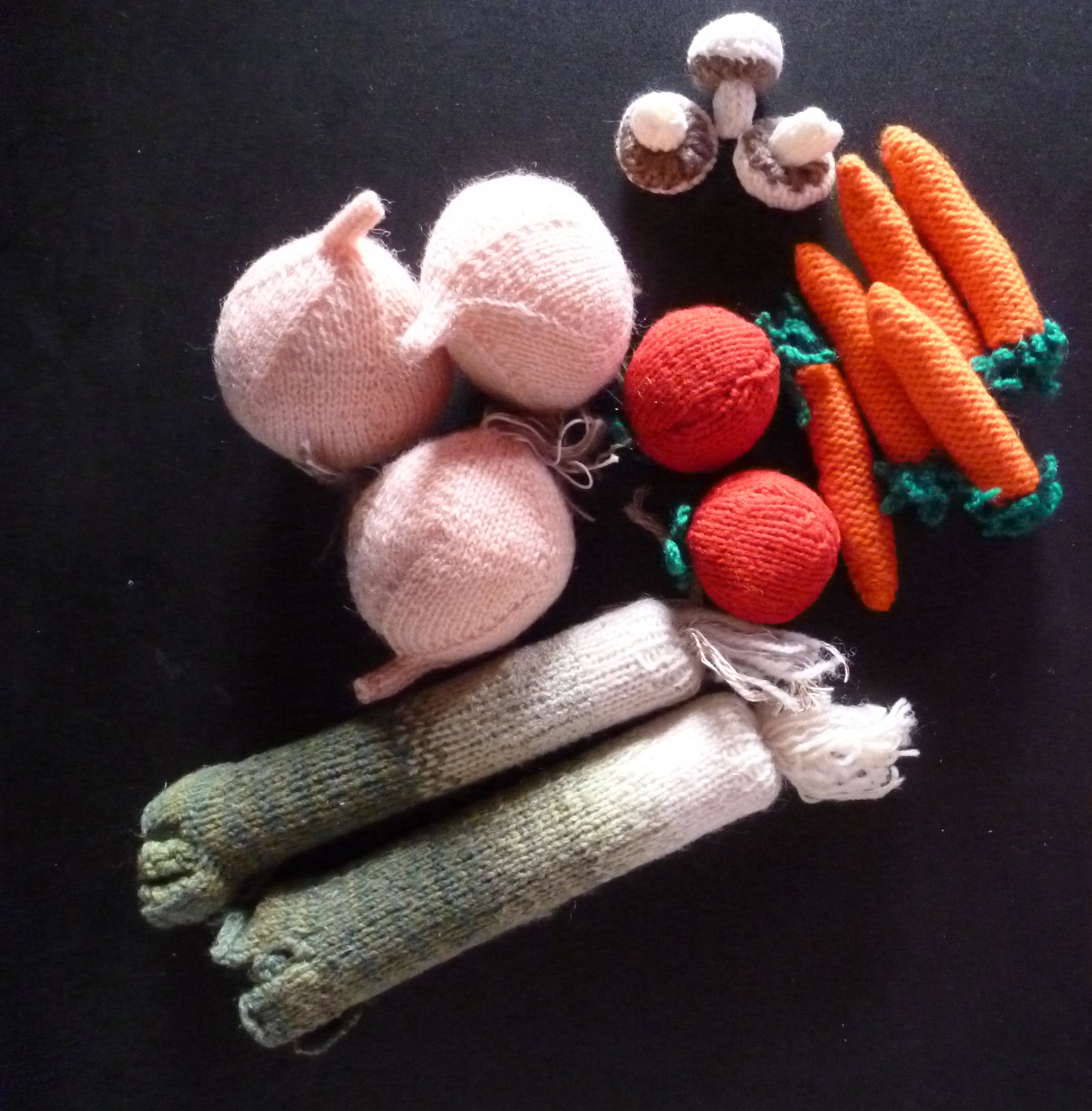
These leeks, onions, carrots, tomatoes and mushrooms were hand knit using synthetic yarn.
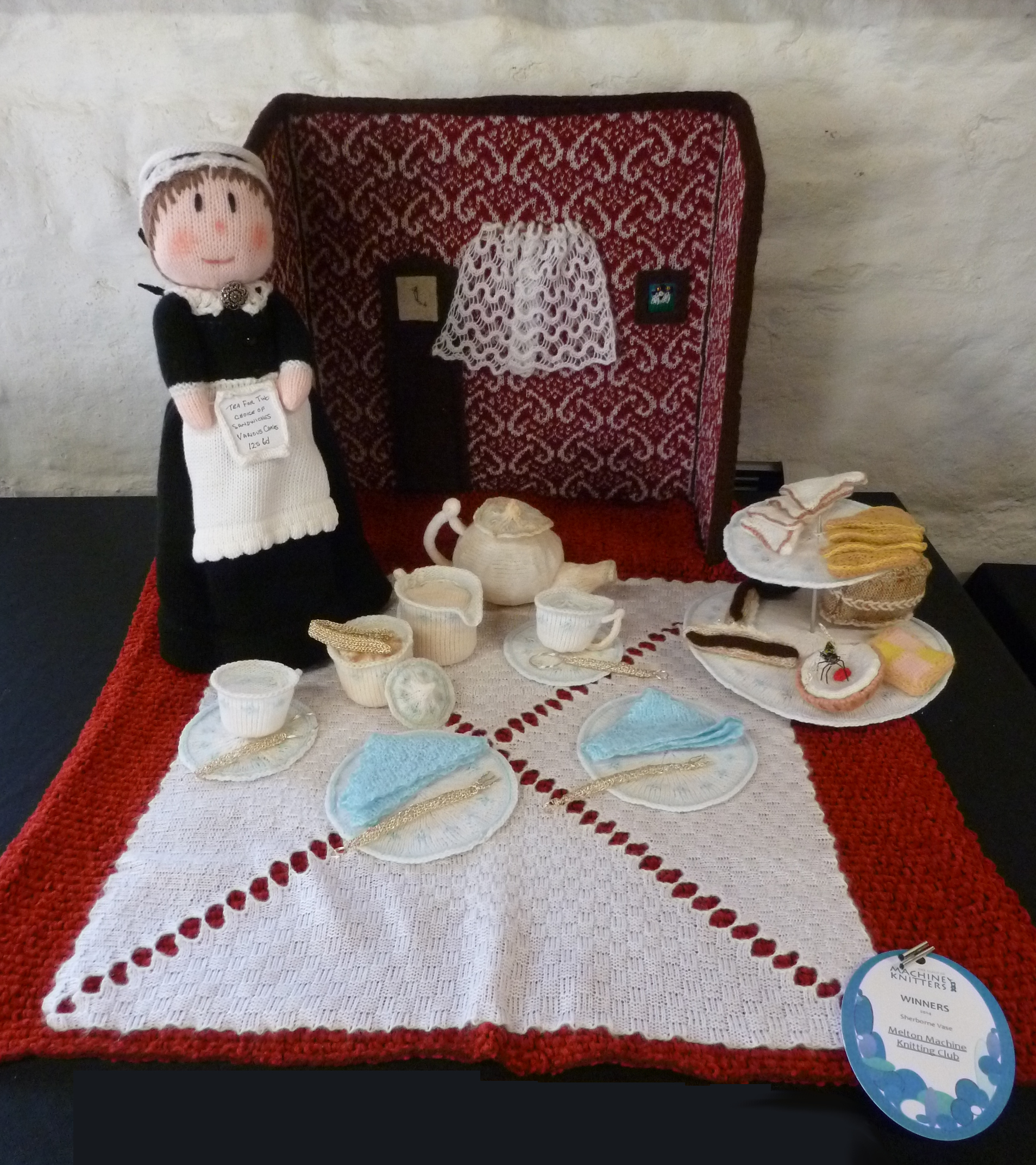
More ambitious is the prize-winning machine knit scene of a traditional afternoon tea, complete with tea room and waitress.
Team challenge
Tom’s highly embellished cardigan illustrated the team challenge of the week – to create a highly textured cardigan that was “original and different.”
An even number of contestants meant that there were three teams of two. With heavy hints from judge Di that bubble stitch would be a good idea, the three teams set off in different directions.
One team chose to use a smiley face as the texture on the back, with cabling on the front and bubble stitch on the sleeves of their yellow cardigan.
The second, using red yarn, chose an unconventional sideways construction with the join along the arms and across the shoulders, which meant that cables could continue at full width from cuff to neck, and mixed bubble and waffle stitch patterns as the foundation for the front and back.
Team three created a cable-based light green cardigan with openwork (eyelet) edging between the main panels and the ribbing.
At this stage in the competition, judging depended on accuracy of stitches details, and impact. After much deliberation, including whether the way the red cardigan had been sewn together was intentional, the visual impact of the red cardigan won the day.
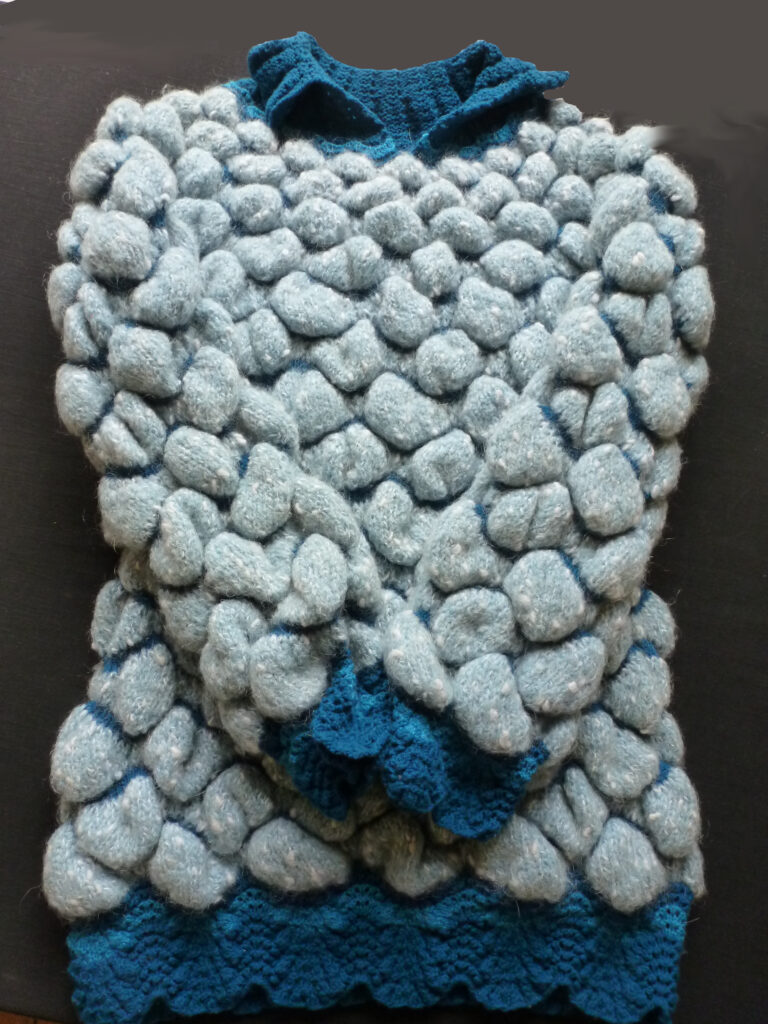
This hand knit sweater certainly has texture – its creator describe it as “pebbles” .
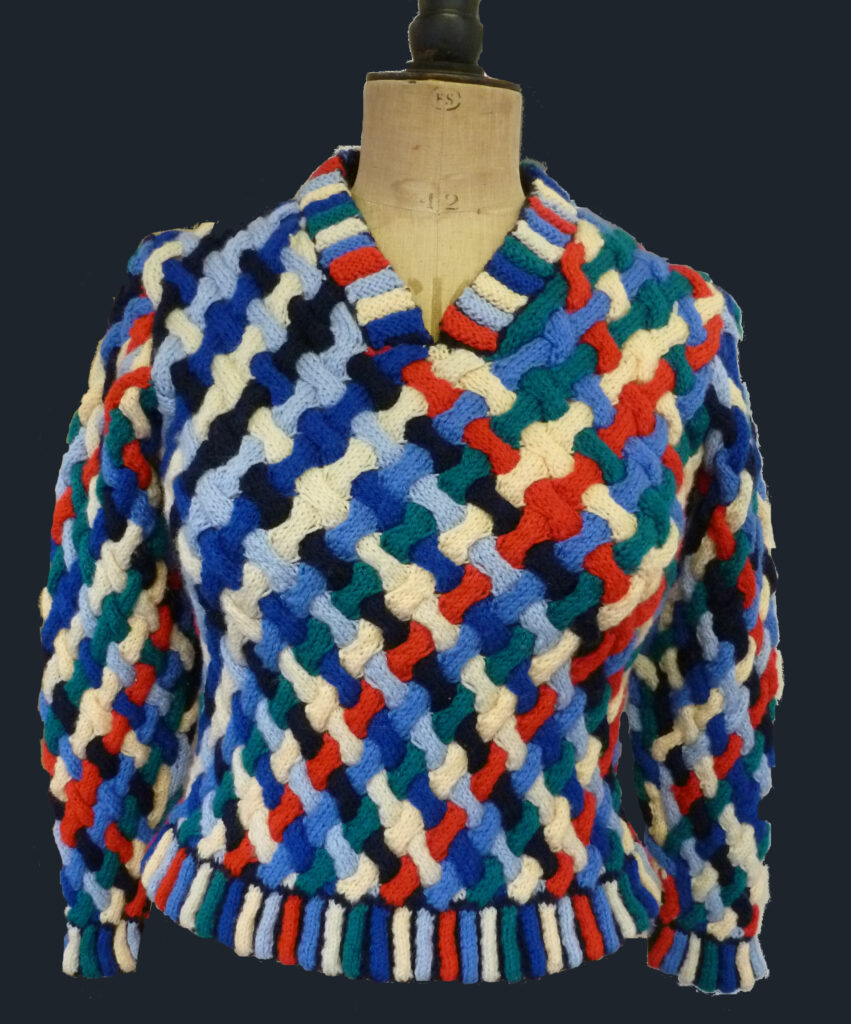
At first sight, this looks like a multi-colour jumper made using “entrelac”, a technique where areas of colour are make by picking up stitches from an adjacent area. Look closer and you will see that it was actually make by crossing cables of different colours.
Learning more about topics raised in this episode
Just as the judges were concentrating on detail in this week’s programme, our section on topics raised also points to details in what happened.
Did you notice the loose-leaf book that showed swatches of different stitch patterns? It is an example of a stitch dictionary. Stitch dictionaries are reference books used by knitters and crocheters when designing or modifying patterns, usually showing pictures of hundreds of different stitch patterns and the instructions for making them.
During his chat with Isaac, Tom was shown Isaac’s notebook where he had written down the results of the calculations he had made to get the right shape for his knitted bun. Isaac had used a technique known as “short rows” to create shape – if you want to learn more about the theory and practice of short rows, we suggest the guide by Tech Knitter (a “knitting guru”).
If you would like to include the bubble stitch used in the programme for your knitting, Wool and the Gang have a tutorial. And if waffle stitch is on your list of things to dry, Nimble Needles shows you how. Different people learn in different ways, so these two tutorials may not match your preferred way of learning – so you can search for these (with “knit” in the search to narrow down the list).
There is no universal language of knitting or crochet, and terms are frequently re-invented with different meanings. This is why you need to read the definition of stitches and abbreviations in every pattern you make – they may be different from what you are used to. So, if you search you will discover that the term “bubble stitch” is also used to describe a “bobble” that is formed by increases and decreases based on single source stitch – itself great for texture, but not what you saw in the Game of Wool.
Next episode
Next week’s challenges are on the themes of jewellery and lace (also called open work as the patterns are formed by holes).
First published: 3 December 2025 12:00 pm. Updated: 4 December 2025 9:27 am.