

Week 6 was Statement Week. The remaining five contestants were individually challenged to make knit or crochet jewellery and as a team to make a knitted lace lampshade.
Di continued her theme of using knitting needles as hair decoration – this time three needles with a knitted bow joining them. She was wearing a black knitted shawl. Sheila wore a red top with an openwork or scarf. Tom’s outfit was a knee length tunic made from white crochet squares with mirror centres.
This weeks individual challenge focussed on creativity and impact, while the team had to demonstrate their ability to follow and knit a complex pattern.
Individual task
This week, the contestants had ten hours to to create a bold, striking and original set of jewellery. Each had to produce something for both neck and wrist, and the two needed to be coherent.
Simon took the challenge to heart, choosing to use metal wire instead of yarn, and a method called “Viking knitting” where the “fabric” is formed around a dowel by creating passing loops of wire through each other by hand, making an end result that is much like “French knitting” or an i-cord. The then drew this through successively narrower holes in a needle gauge, in the same way that wire is made, to make a fine tube. While liking the design and concept, the judges had difficulty imagining anyone wearing it because of the sharp ends of the cut wire (the Yarn Barn didn’t offer soldering equipment to make them safe).
Holger went even more off-piste with his choice of “yarn”. Starting from scratch, he had cut a black bin liner into strips that he used to knit a neckpiece and bracelet. He provided contrast at the neck with white crochet lace. The judges commented on the unexpected iridescent colours, but would have preferred to see white in the bracelet as well.
Ailsa used a theme of “Scotland” for her knit cabled necklace and bracelet. The judges particularly liked the highlighting in the thistle on the bracelet and would have liked to have seen it repeated on the necklace.
Isaac chose a daisy chain as his inspiration. Sheila particularly liked the large pendant with its hanging petal, but as a whole the set was judged to be uninspiring.
Lydia chose to use mercerised cotton to crochet a broad neckpiece that extended to the upper chest with matching cuff. With a simple colour scheme of dark neck and lighter lattice, the piece looked spectacular on the mannikin and showed real skill – although simple in concept, a lattice needs to be flawless because the smallest mistake or unevenness is obvious in the finished item. Unsurprisingly, this was judged to be the best piece.
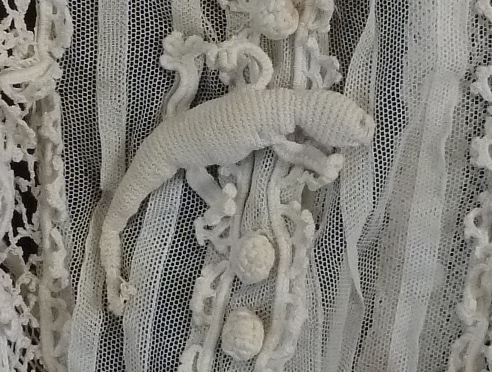
This crochet lizard would make a dramatic focal point for some crochet jewellery. This is a detail of an Irish Crochet jacket in the Knitting & Crochet Guild collection.
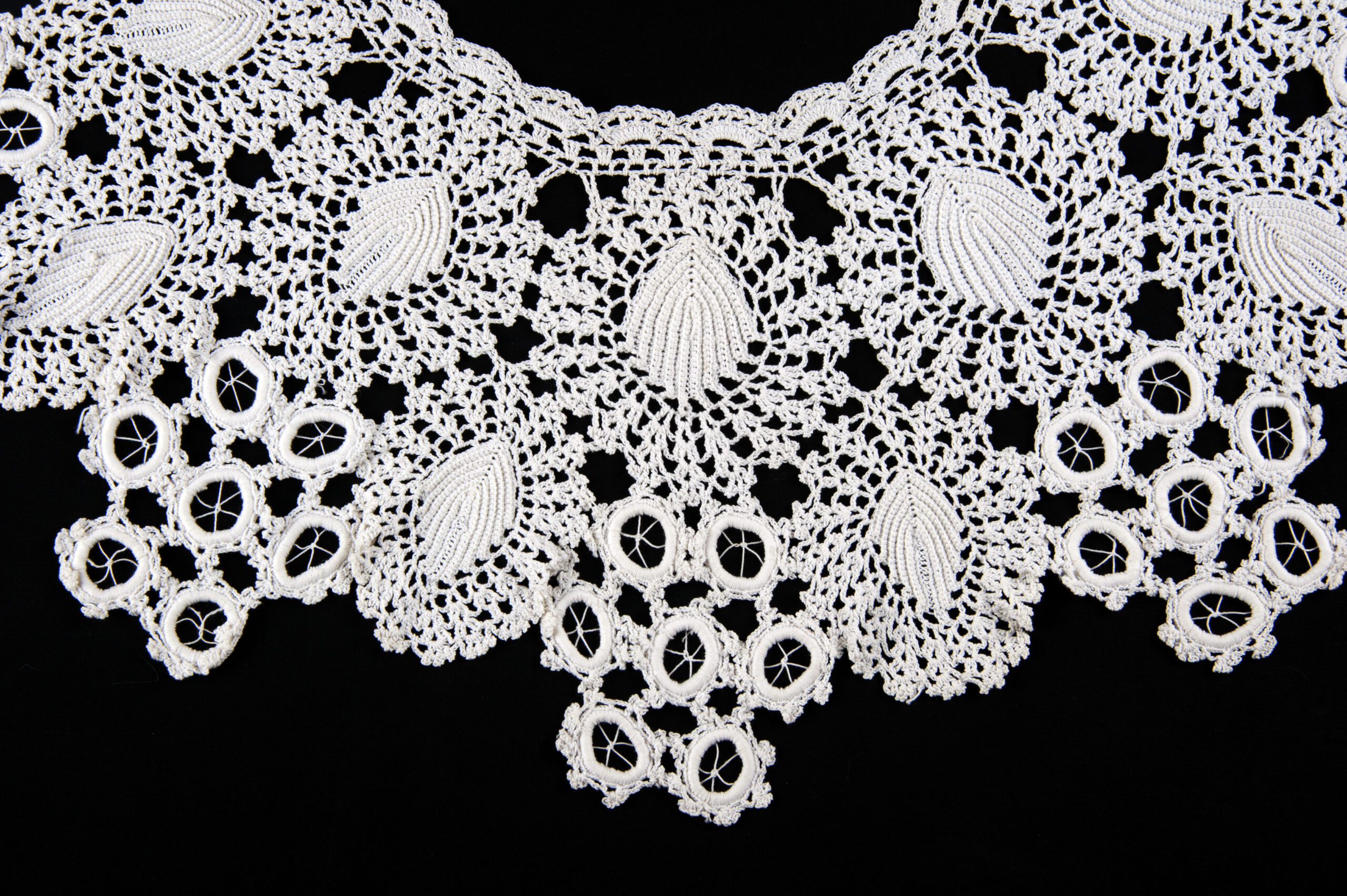
A white crochet collar from the Knitting & Crochet Guild collection..
Team challenge
In this episode the contestants were tasked with each knitting a lace panel that would be used to create a lampshade.
Everyone was given the same pattern based on a traditional Shetland motif of a pineapple. There were 66 stitches in each of the 80 rows. Unlike many lace patterns that have every second row as a “rest row” of straightforward knit or purl, each of the 80 rows had increases and decreases. The pattern was provided as a chart, and everyone had to use the same linen yarn. Competitors were given twelve hours to complete the task. The judges would be looking for the ability to follow the pattern and for accuracy in the completed product. Shining a light through the finished panels clearly showed mistakes. with no visible mistakes, Isaac’s panel was judged to be the best.
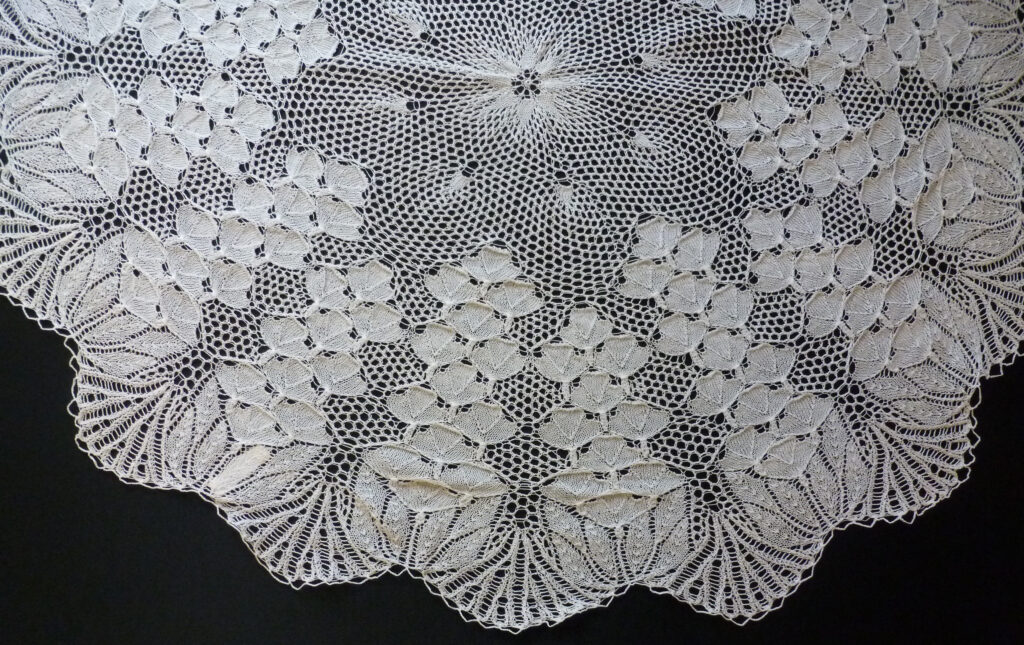
Detail from a circular table cloth, knit with white cotton using a foxglove pattern radiating from the centre. From the Knitting & Crochet Guild collection.
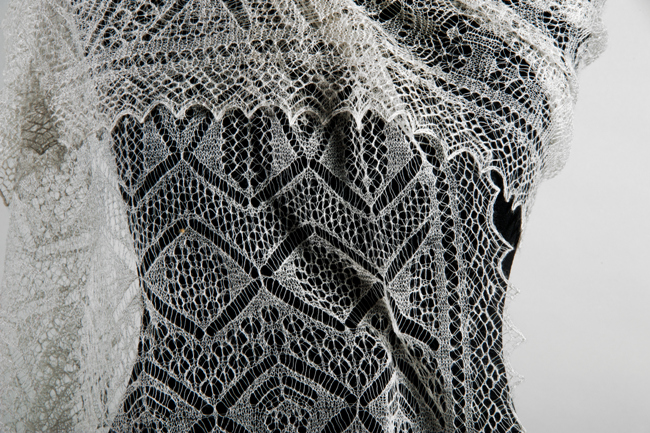
Shetland lace stole (believed to have been knit in Shetland). From the Knitting & Crochet Guild Collection.
Learning more about topics raised in this episode
Jewellery
Slipknot 136 (September 2012) had an article on a crochet friendship bracelet. Members can follow this link to download a copy. Slipknot 121 (September 2008) had an article on “Diamonds are a girl’s best friend” – available for members who are logged in to download from this link.
If you are a machine knitter, you might be interested in how to use beads in your knitting. We have a video (recorded for Unconvention 2020) that members may view if they are logged in: Machine Knitting Hand Tooling Techniques: Beads.
Lace
As we saw in the programme, lace knitting requires concentration and patience (not so easy in a filming environment).
We have guidance on lace knitting in our learning section.
Machine knitters might benefit from viewing the following video that were made for our “Unconvention” in 2020 on Machine Knitting Hand Tooling Techniques: Manual Lace.
The programme mentioned three tips for lace knitting. As a reminder, these were:
- Count, count, count. With so many decreases and yarn over increases, it is easy to gain or lose stitches in lace. Try to spot this as quickly as possible by counting the stitches after each repeat and every row. It is helpful to compare the stitches you have made with the chart as you count.
- Stitch markers can help you with counting. Place a stitch marker after every repeat to make it easier to keep track. If there isn’t a repeat, place the markers at key points in the row. Use “removable markers” (such as those shaped as padlocks or light bulbs) so you can take them off if the yarn ends up going through them.
- Lifelines. Everyone makes mistakes, and correcting these if they are more than a couple of rows down in a lace project can be frustrating. A lifeline is a thin, smooth, and usually contrasting thread that you can feed through the loops after you finish a row (and make a note of which row it marks). If you find a mistake, you can just pull out your row and it will only unravel until it meets your lifeline.
Next episode
Next week’s theme is “Charity knit to Fashion” – which is likely to give you some upcycling ideas.
First published: 10 December 2025 4:48 pm. Updated: 10 December 2025 4:48 pm.